Indian Steel Market Valuation to Reach 220.5 Million Tons by 2034, at 5.95% CAGR
According to IMARC Group's report titled "India Steel Market Size, Share, Trends and Forecast by Type, Product, Application, and Region, 2026-2034", the report offers a comprehensive analysis of the industry, including market share, growth, trends, and regional insights.
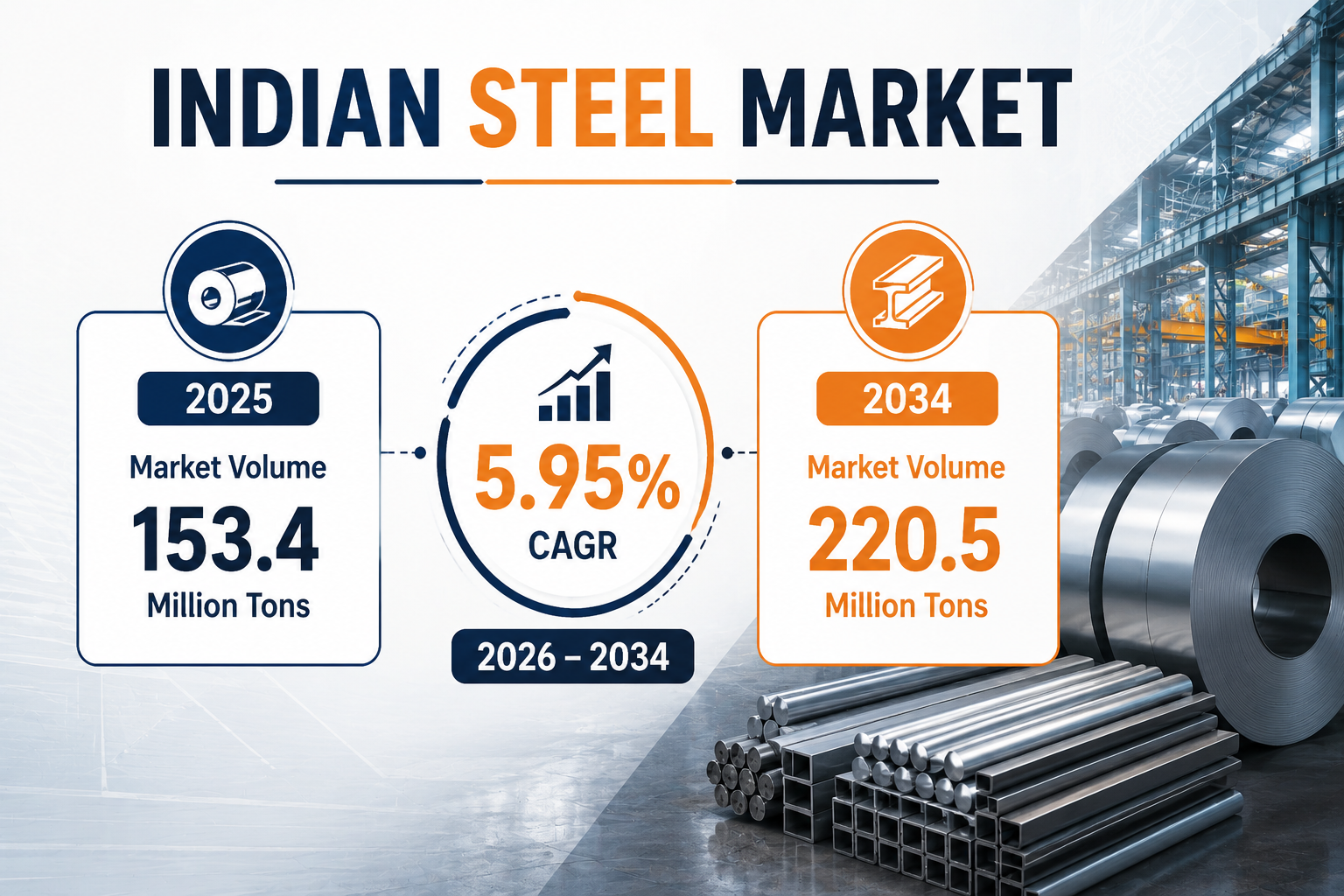
The Indian steel market size was volumed at 153.4 Million Tons in 2025 and is projected to reach 220.5 Million Tons by 2034, growing at a compound annual growth rate (CAGR) of 5.95% during the forecast period from 2026-2034.
Market Statistics At-A-Glance
-
Current Market Size 2025: 153.4 Million Tons
-
Projected Market Size 2034: 220.5 Million Tons
-
CAGR: 5.95%
-
Forecast Period: 2026-2034
The India Steel Market: A 220.5 Million Ton Strategic Transformation Powered by Infrastructure Capex, Green Steel Investments & Automotive Growth signals a decisive pivot from volume-driven production to value-added, sustainable manufacturing. For institutional investors, steelmakers, and downstream manufacturers, this represents a structurally sound, policy-backed opportunity at the intersection of record government capital expenditure, decarbonization mandates, and rising domestic consumption.
Key Trends in the India Steel Market
- Shift Toward Value-Added and Specialty Steel: A clear trend is the rising demand for high-value steel products such as galvanized, coated, electrical, and automotive-grade steel. The automotive and construction sectors are increasingly driving demand for flat steel products, while industrial applications are pushing specialty steel adoption. Government incentives under the Production Linked Incentive (PLI) scheme are further accelerating domestic production of specialty steel to reduce import dependency.
- Rapid Capacity Expansion and Investment Cycle: India’s steel industry is undergoing aggressive capacity expansion, with major players investing heavily in new plants, brownfield expansions, and modernization projects. Installed steel capacity is projected to rise significantly over the next decade, supported by large-scale investments in integrated steel plants and downstream processing infrastructure. This reflects confidence in long-term domestic demand growth and export competitiveness.
- Infrastructure-Led Demand Acceleration: Infrastructure development remains the dominant demand driver, with construction accounting for the largest share of steel consumption. Government initiatives such as housing schemes, metro rail expansion, industrial corridors, and logistics infrastructure are sustaining strong demand for structural steel. This infrastructure-heavy growth model ensures stable baseline consumption even during global downturns.
- Green Steel and Decarbonization Push: Decarbonization is emerging as a defining industry trend, with leading steelmakers investing in hydrogen-based steelmaking, energy-efficient processes, and carbon reduction technologies. The transition toward “green steel” is being driven by both domestic sustainability goals and global trade pressures such as carbon border regulations, pushing companies to modernize production processes.
- Rising Role of Electric Arc Furnace (EAF) Production: Secondary steelmaking through electric arc furnaces is expanding rapidly, supported by increasing scrap availability and policy support for vehicle scrappage. This is gradually shifting the production mix away from traditional blast furnace routes toward more flexible and energy-efficient steelmaking systems.
- Import Substitution in High-Grade Steel: Despite being a major global producer, India continues to import certain high-grade and specialty steel products. This gap is driving a strong import substitution trend, supported by policy incentives and domestic capacity additions in alloy, electrical, and high-performance steel segments.
Evaluate Market Opportunity Before Investing – Request for a Sample Report
Key Growth Drivers of the India Steel Market
- Strong Infrastructure and Government Capital Expenditure: Massive public investment in infrastructure is the most important growth driver. High budget allocations toward roads, railways, housing, and industrial corridors are creating sustained steel demand across construction and structural applications. Government-led capex continues to act as a long-term demand anchor.
- Rapid Urbanization and Industrialization: India’s expanding urban population, rising industrial output, and growing manufacturing base are significantly increasing steel consumption intensity. Urban infrastructure development, commercial real estate expansion, and industrial cluster growth are strengthening long-term structural demand.
- Automotive and Engineering Sector Expansion: The automotive industry is a major consumer of flat steel, supported by strong vehicle production and rising demand for high-strength lightweight materials. Growth in engineering goods, machinery, and capital equipment manufacturing is also boosting steel consumption across value-added segments.
- Favorable Policy Support and Industry Incentives: Government initiatives such as the National Steel Policy, PLI schemes for specialty steel, and infrastructure development programs are strengthening domestic production capacity. Policy support is also improving raw material availability and encouraging technology upgrades across the industry.
- Strong Domestic Demand vs. Low Per Capita Consumption: India’s per capita steel consumption remains significantly lower than global averages, creating a large long-term growth runway. As economic development accelerates, steel demand is expected to expand steadily across residential, industrial, and infrastructure applications.
Market Segmentation Breakdown
Type Insights: (Flat Steel dominates with 54.2% of market share in 2025)
- Flat Steel
- Long Steel
Product Insights: (Structural Steel leads with 33.6% of market share in 2025)
- Structural Steel
- Prestressing Steel
- Bright Steel
- Welding Wire and Rod
- Iron Steel Wire
- Ropes
- Braids
Application Insights: (Building and Construction dominates with 41.9% of market share in 2025)
- Building and Construction
- Electrical Appliances
- Metal Products
- Automotive
- Transportation
- Mechanical Equipment
- Domestic Appliances
Regional Insights: (West & Central India leads with 34.7% of market share in 2025)
- West & Central India
- North India
- South India
- East India
By IMARC Group – Top Competitive Landscape & Positioning:
Covering an in-depth analysis of the competitive landscape, market structure, key player positioning, competitive dashboards, top winning strategies, and detailed profiles of all major industry participants you will gain access to all these exclusive insights within the full research report.
Key players shaping India's steel landscape include:
-
Steel Authority of India Limited (SAIL)
-
JSW Steel Limited
-
Tata Steel Limited
-
Jindal Steel and Power Limited (JSPL)
-
Rashtriya Ispat Nigam Limited (RINL/Vizag Steel)
-
APL Apollo Tubes Limited
-
Jindal Stainless Limited
Recent News & Developments:
-
January 2026: JSW Steel announced its proposal to accelerate capacity expansion to 50 million tonnes a year by 2030, with estimated investment of over ₹2 lakh crore over the next five years in its Dolvi plant in Maharashtra and a new greenfield project in Odisha — one of the largest single investments in the Indian steel sector.
-
October 2025: Jindal (India), a manufacturer of downstream steel products, commissioned 0.6 million metric tons of additional downstream steel capacity at its plants in West Bengal, marking near completion of its expansion project.
-
May 2025: Tata Steel India announced plans to increase hot strip mill capacity at Kalinganagar in Odisha to increase production capacity of flat products intended for automotive and packaging industries, with the plant being developed to have integrated capacity of 8 million tons annually.
Request Customized Data Tailored to Your Interest
Note: If you need specific information that is not currently within the scope of the report, we can provide it to you as a part of the customization.
Frequently Asked Questions (FAQs):
Q1. What is driving the growth of India's steel market?
Growth is fueled by record government capital expenditure (₹12.2 lakh crore for FY 2026-27), rapid urbanization (urban population expected to reach 630 million by 2030), automotive sector recovery (28.4 million vehicles produced in FY 2024-25), and the electric vehicle transition requiring specialized steel grades.
Q2. How are government schemes transforming the sector?
The Production-Linked Incentive scheme for specialty steel (₹6,322 crore outlay), vehicle scrapping policy supporting EAF capacity expansion, and National Monetization Pipeline (₹5.8 lakh crore) together form the cornerstone of India's steel industrial policy.
Q3. Which type dominates the India steel market?
Flat steel commands a dominant share of around 54.2% in the type segment, favored by the automotive industry which uses large volumes of cold rolled flat products and coated sheets, along with infrastructure applications for roofing and cladding.
Q4. Why is green steel the segment to watch?
The Indian steel industry contributes approximately 8% of total industrial CO₂ emissions. With Tata Steel targeting 1.8 tonnes CO₂ per tonne by 2030 and JSW Steel pursuing hydrogen-based production, green steel investments represent a major structural transformation theme.
Q5. How is the automotive industry shaping steel demand?
The automotive sector is the second-largest steel-consuming sector in India, producing over 28 million vehicles in FY 2024-25. EVs require high-strength steels for lighter bodies and battery enclosures, while non-grain-oriented electrical steels are needed for motors and generators.
Q6. What is India's steel production ranking globally?
India has established itself as the world's second-largest steel-producing nation with raw steel output exceeding 144.3 million tonnes in FY 2023-24, positioning the country as a global steel powerhouse.
Strategic Insight & Verdict:
The steel industry in India now contributes significantly to the country's manufacturing GVA, with the sector poised to sustain steady volume growth through 2034 backed by infrastructure modernization, automotive evolution, and industrial expansion. The convergence of a ₹12.2 lakh crore infrastructure budget, PLI scheme for specialty steel, green steel transition investments, and rapid EAF capacity expansion positions India's steel sector as a long-term, multi-decade growth engine. For investors and manufacturers, the most compelling opportunities lie in specialty steel production, green steel technologies, automotive-grade flat products, and downstream processing capabilities — making this one of the highest-conviction industrial bets in the Indian manufacturing sector.